

Metacosmos
My own technology for art in real time. A platform of nodes, live code and outputs to several screens, built work by work.
Metacosmos is the technology I build to make my work. It is a platform for real-time image where I connect video, cameras, sound, code and generated media on a canvas of nodes, and send the result to screens and projectors.
Each installation and each performance asked for a tool that did not exist in the form I needed, so I made it. Metacosmos is the sum of those solutions, tested in the room and kept in one system.
Technology made by hand
I trained in drawing, painting and wood sculpture from the age of eleven. A workshop teaches that the tool is part of the work. A potter prepares the clay before it reaches the wheel, and a painter grinds pigment and primes the canvas until the surface answers the hand. Nobody in that tradition takes the material as given.
I work with technology in the same way. I write my own software and fit it to the idea of each piece, to its look and to the room where it will be shown. A ready-made tool brings decisions taken by someone else. Building it myself keeps those decisions inside the work.
“To build the systems and technologies needed to take art beyond the screen, transform perception and carry the light of creation to the stars.”
One system from many works
Every work I have made with code asked for its own solution. One needed a program to turn a rule into an image, another a way to mix video live, another a system to send one picture to several projectors. I tried existing applications, wrote my own and tested them in front of an audience.
Metacosmos gathers those solutions, applications and experiments in a single technology. What worked in one piece became a tool for the next, and every new work adds to it.
A canvas of nodes
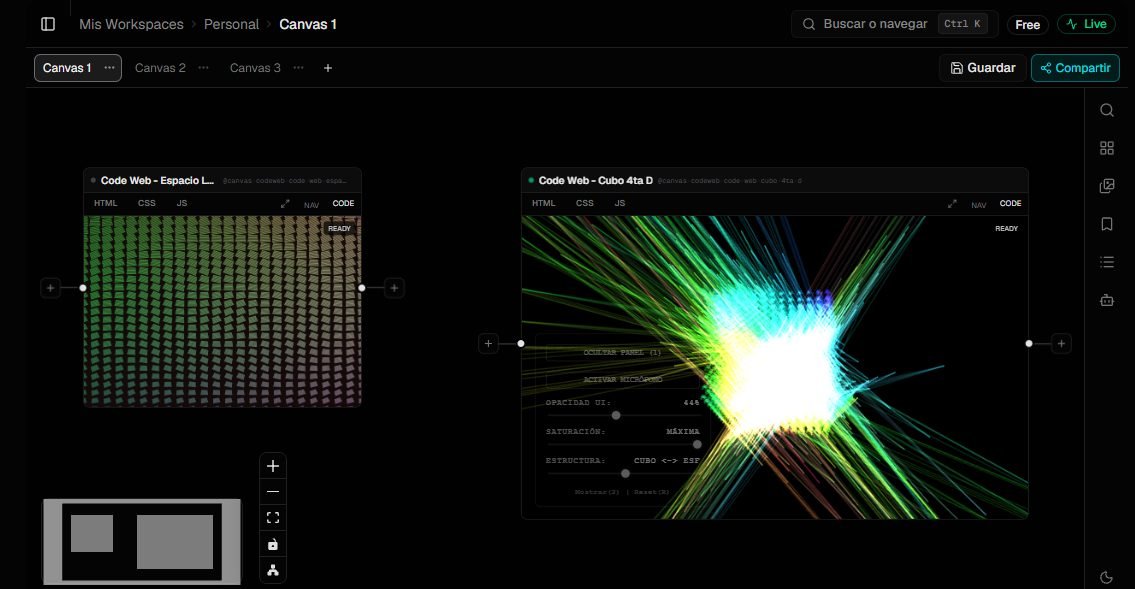
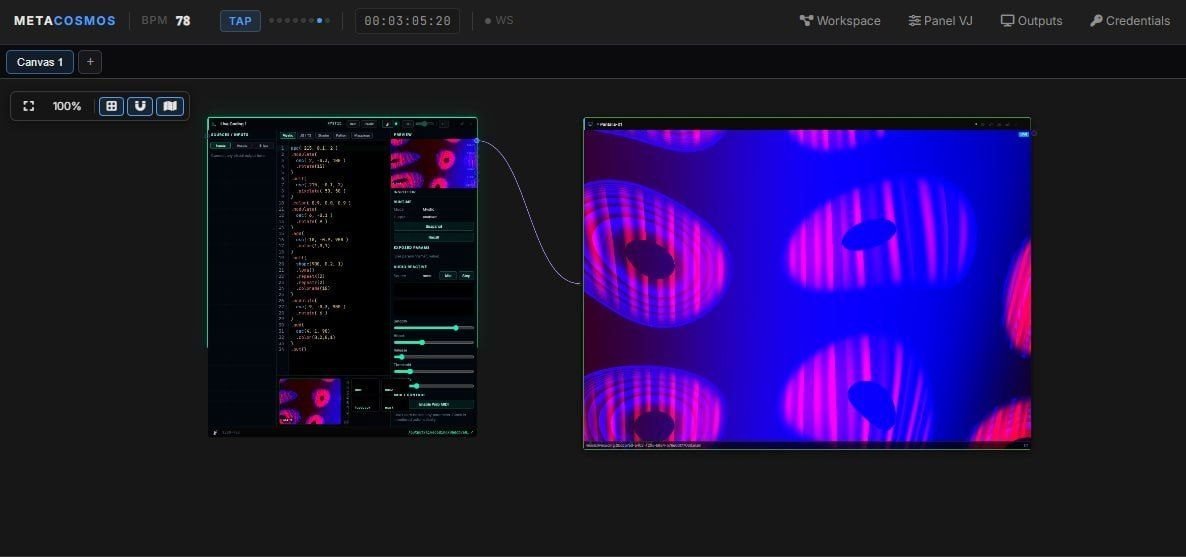
The centre of Metacosmos is a canvas without edges. On it, every source, effect and output is a node, a box with inputs and outputs that I join with cables as in a circuit. A node can be a video, a camera, a sound or a piece of live code.
The signal runs along the cables from the sources to the screens. Changing a connection changes the image at once, so I compose by drawing the path of the signal. The figure below is a simplified patch.
Switch the sources on and off
Types of node
- Screen
- YouTube
- Video
- Camera
- Audio
- Mystic
- Timeline
- VJ
- Multi-screen
- OBS
- 3D
- VFX
- Web
- AI
Six tools in one system
Around the canvas I built the tools that a live work needs. Each one came from a concrete need on stage or in an exhibition room, and they keep time with the BPM of the music.
Metacosmos processes data in real time. It has interactive AI and pattern recognition technologies built in, and with them I create projects that interact with people live.
- 01Visual nodesA canvas without edges where sources, effects and outputs connect like a circuit.
- 02VJ performanceLive mixing of video layers, with crossfades and synchronisation to the BPM.
- 03TimelineSequencing and automation of every moment of a show, to the frame.
- 04Live codingGLSL shaders written in real time with Mystic, the visual synthesiser of the platform.
- 05Multi-screenSimultaneous output to several screens, projectors and streams.
- 06AI mediaGeneration and transformation of media with AI, through OpenAI, Gemini and ElevenLabs.
Code written in view of the audience
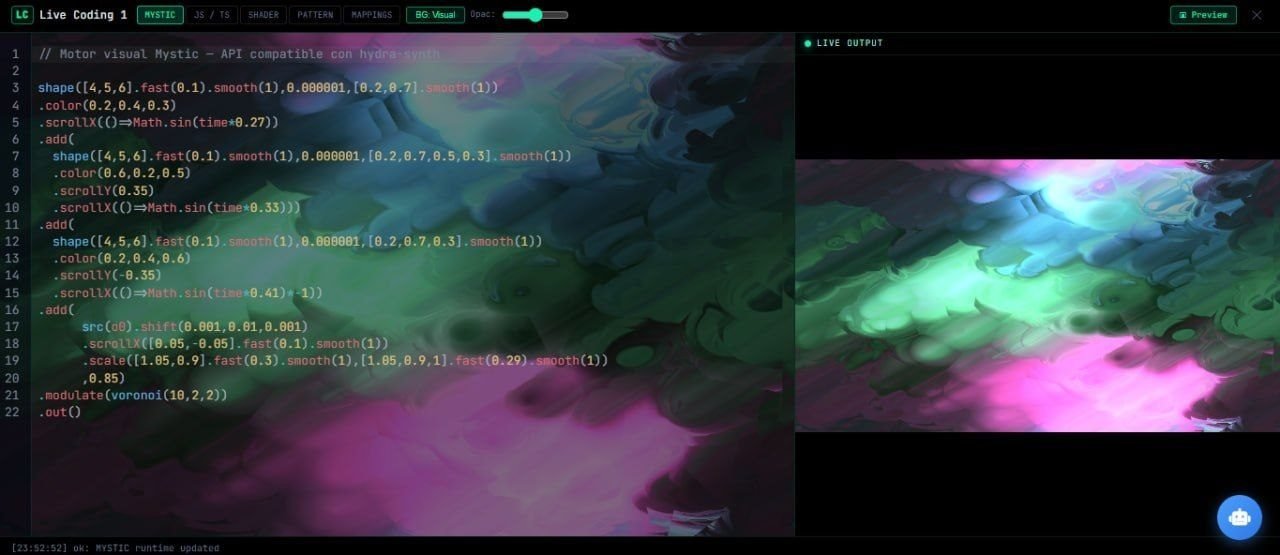
Live coding is the practice of writing a program while it runs, so that each line changes the image as soon as it is typed. In Metacosmos it has its own node and its own synthesiser, Mystic. I wrote Mystic for the platform, and it is compatible with the programming language of Hydra. It also runs GLSL shaders, the small programs that compute the colour of every pixel.
I program the way I draw. A line of code behaves like a stroke that can be corrected, repeated or erased while the audience watches. The screenshots show the platform at work.
From the studio to the room
A work made with Metacosmos passes through three moments. First I build the patch in the studio. Then I play it live, alone or with other artists. At the end the image leaves the computer and takes the shape of the room, on one screen or on many.
Each venue has its own number of screens and its own proportions, so I set up the outputs again for every room.
- 01BuildA workspace of nodes joins video, images, sound and code on one canvas.
- 02PerformThe set runs live, with the BPM in sync and control over transitions and layers.
- 03ExpandThe image goes out to several screens and travels over the network.
A laboratory for research on art
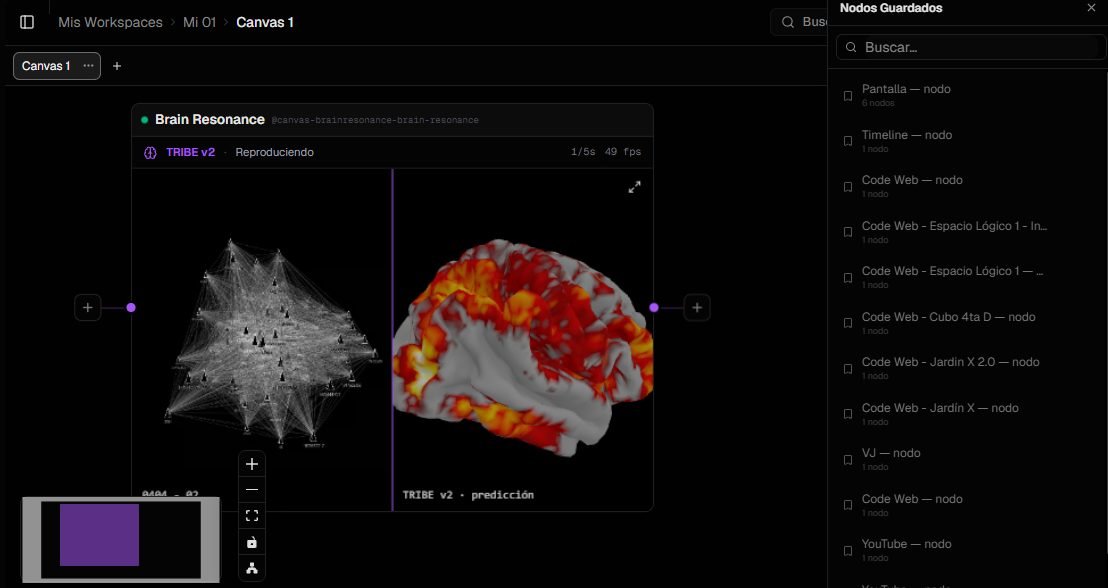
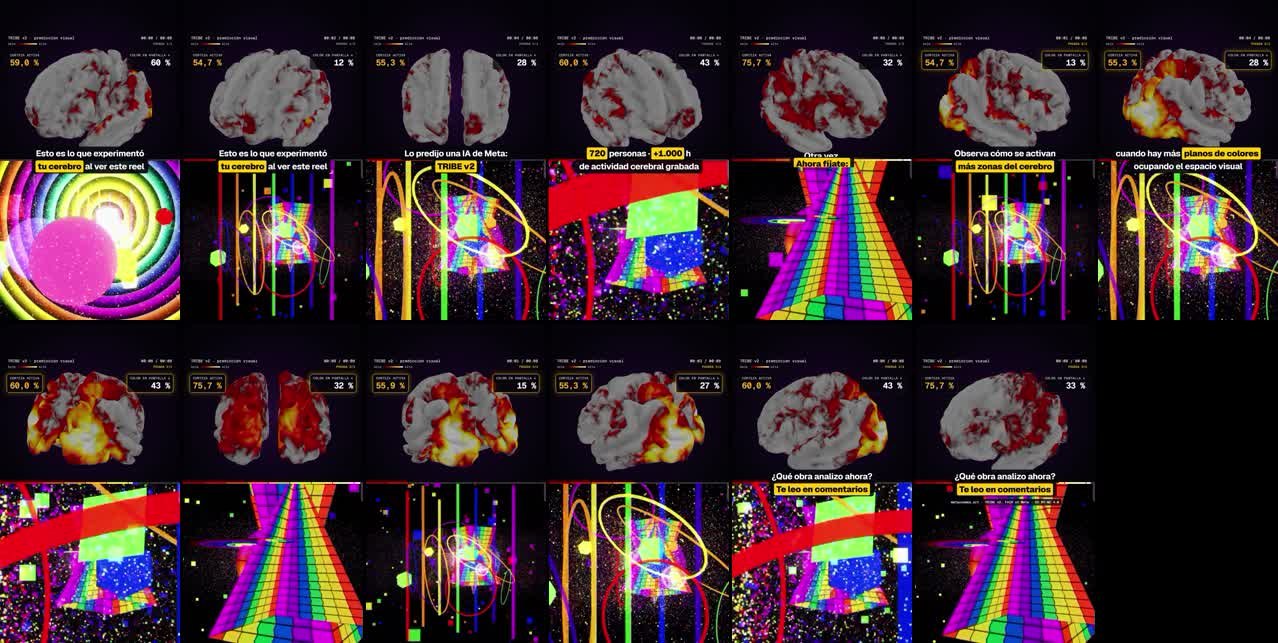
With time Metacosmos has grown into a large laboratory for research on art. Among the technologies I have used in my practice, one of the most relevant is artificial intelligence that helps me understand the effect of a work on people. One of these models is TRIBE v2, developed by the research laboratories of Meta. It receives video, sound or text and predicts the activity that they would produce in the human brain.
Liminal Garden came out of an earlier analysis inside this research. It began as a series of videos, studies of image and sound made to stimulate the viewer through the codes of art. Many of them were developed by painters of the 20th century who worked in abstraction, Futurism and kinetic art. They studied colour, composition and perspective.
The figures below show one of those tests. I gave the model one of my videos and it returned a map of the cortex for every moment. The predicted activity reaches more areas when planes of colour fill more of the visual field. The map is a prediction of the model, made without scanning any viewer.
The sound of rivers, forests and cities
Inside Metacosmos I have also developed technologies to work with hydrophones, the microphones made to record under water, and to handle low-frequency sound and vibrations. With them I created protocols that transmit the sound of rivers, forests and cities in real time.
When the signal reaches the canvas, a synthesiser turns it into image. The two videos below come from the Manzanares, the river of Madrid. In the first, a hydrophone captures the sound of the water. In the second, a node receives that signal as it arrives and passes it to Mystic, which converts the river into visuals.
The technology inside the work
In Liminal Garden, the performance I made with the sound artist and instrument maker Gabriel Barreto, Metacosmos generates the image on a remote server and returns it to three screens. The audience changes one of them from their phones, and the room works as one more node of the system.
Metacosmos is also the title of the exhibition I presented at Sala Siroco, in Madrid, in May 2026. The technical challenges I faced in that exhibition led me to create this technology and to bring all the solutions I already had into one place.
Sheet and access
Metacosmos is open to other artists. It is available at metacosmos.art, where anyone can open a free account.
The technology
- Name
- Metacosmos
- Type
- Platform for visual art in real time
- Author
- Jaco Casstillo
- Engine
- Mystic, a synthesiser of its own that is compatible with the language of Hydra, and GLSL shaders
- Data
- Processed in real time, with interactive AI and pattern recognition built in
- Outputs
- Several screens, projectors and streams, at 4K and above
- AI
- OpenAI, Gemini and ElevenLabs, with the keys of each artist
- Website
- metacosmos.art
Shown in
- 2026Liminal Garden, interactive audiovisual performance with Gabriel Barreto (osonoro)
- 2026Metacosmos, Sala Siroco, Madrid, Spain

