

Liminal Garden
El viaje de la Kalíptera. Interactive audiovisual performance, 2026. Generative image in real time, the audience’s phones and Kalíptera, an instrument by Gabriel Barreto.
Liminal Garden is a 40-minute audiovisual performance for two artists, three screens and the phones of the audience. On stage, the sound artist and instrument maker Gabriel Barreto plays Kalíptera, the electroacoustic instrument he built. I write the image live on Metacosmos, a platform of my own.
The piece follows a flight through generative gardens, led by the sound of Kalíptera. Anyone in the room can take part from a phone, and the screens answer to the music and to the room at the same time.
A garden that is crossed
The title comes from Jardines liminales, a research project on threshold places, the kind that are crossed rather than reached. Each garden is a mental ecosystem built from geometry, movement, light and sound. It works as a passage that shifts perception, towards thought and altered states of consciousness. There the borders between what exists and what is imagined, and between the organic and the artificial, start to fade.
The image stops being a still surface and becomes a process in time. Repetition, change, growth and movement act on it as the variables of a painting. For me the garden is a speculative system. Nature appears in it rebuilt from rules, which produce other ways of seeing and thinking.
- Layer 1SoundKalíptera and its chain of synthesis. The music sets the tempo, density and energy of the whole piece.
- Layer 2ImageGenerative gardens that follow the sound, with video art and XR visuals. Some images and videos are made with AI, and the code is written live in view of the audience.
- Layer 3AudienceEach phone in the room becomes a node of the network that drives the screens.
A flight through the gardens
Kalíptera’s shape, its hybrid sounds and the gestures it asks of the player suggest an insect in flight. During the performance the audience takes the place of that insect and crosses an endless series of gardens, each with its own palette, speed and scale of notes. The gardens react to the sound. They grow, beat and change with each vibration.
This flight needs WebGL, which this browser does not offer.
An instrument with wings
Kalíptera grows out of the kalimba, its closest ancestor. Its name joins kalimba with ptera, the Greek word for wings. Gabriel built two wooden sound boxes with 13 steel keys each and hinged them on a central spine of controls. Opening and closing these wings is the main gesture of the player.
Contact microphones pick up the keys, and an ESP32 board reads the knobs, buttons and sensors on the spine. In plugdata, four synthesis generators transform the acoustic sound before the mixer, the effects and the master output. The software analyses the spectrum and the amplitude in real time to detect notes and attacks.
The instrument follows Voyager, the interactive improvising program by the American composer and trombonist George Lewis. Kalíptera captures fragments of the performance, transforms them and answers with new material. For Gabriel, this makes the player and the machine a duet without hierarchy. In 2026 Kalíptera was one of 10 finalists in the Guthman Musical Instrument Competition at Georgia Tech, in Atlanta.
Drag to turn · tap a key or a button
Photographic plan Tap a photograph to see the model in the same position
Central spine controls
Left wing 13 keys · keyboard A to L
Right wing 13 keys · keyboard Q to O
Synthesis chain plugdata
A 3D model rebuilt from photographs of the instrument. The simulation follows its signal chain, and after each phrase the machine answers with transformed material.
Kalíptera in concert
Concert of the finalists of the Guthman Musical Instrument Competition, Georgia Tech, Atlanta, 2026. The video starts at Kalíptera’s performance.
The visual instrument
Metacosmos is a platform for real-time visuals that I program and play as an instrument, a mixing desk and a network at once. On a canvas of nodes I connect sources such as web code, live coding, video and generated images to the output screens. The nodes keep time with the BPM of the music, and the parts of the system talk to each other through WebSocket, a protocol that keeps a connection open in both directions.
The live coding console includes Mystic, the synthesiser of Metacosmos, which is compatible with the programming language of Hydra, along with modes for code, shaders, patterns and mappings.
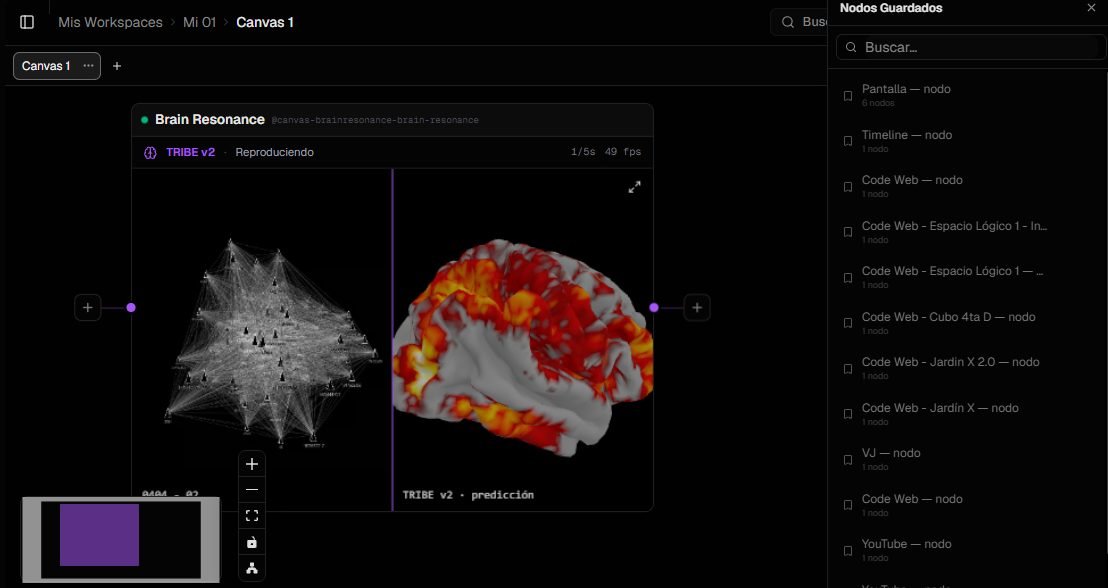
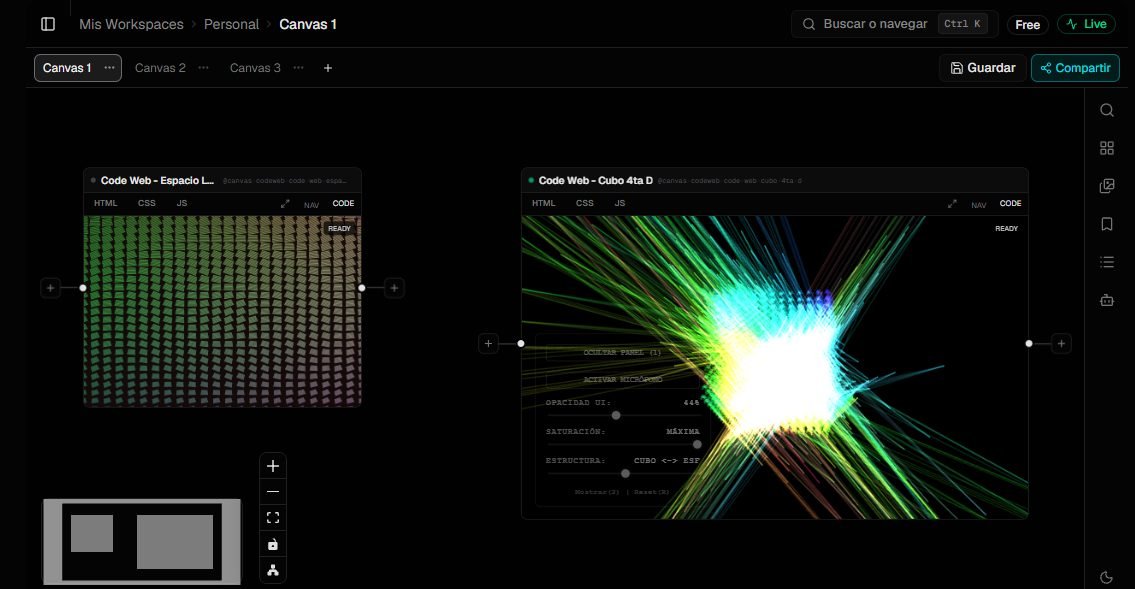
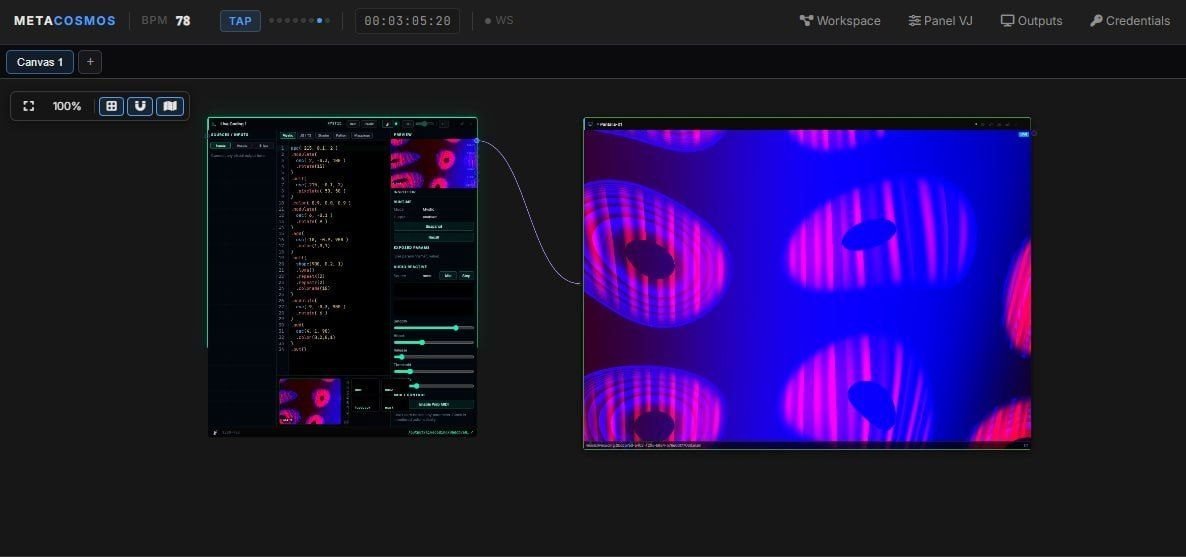
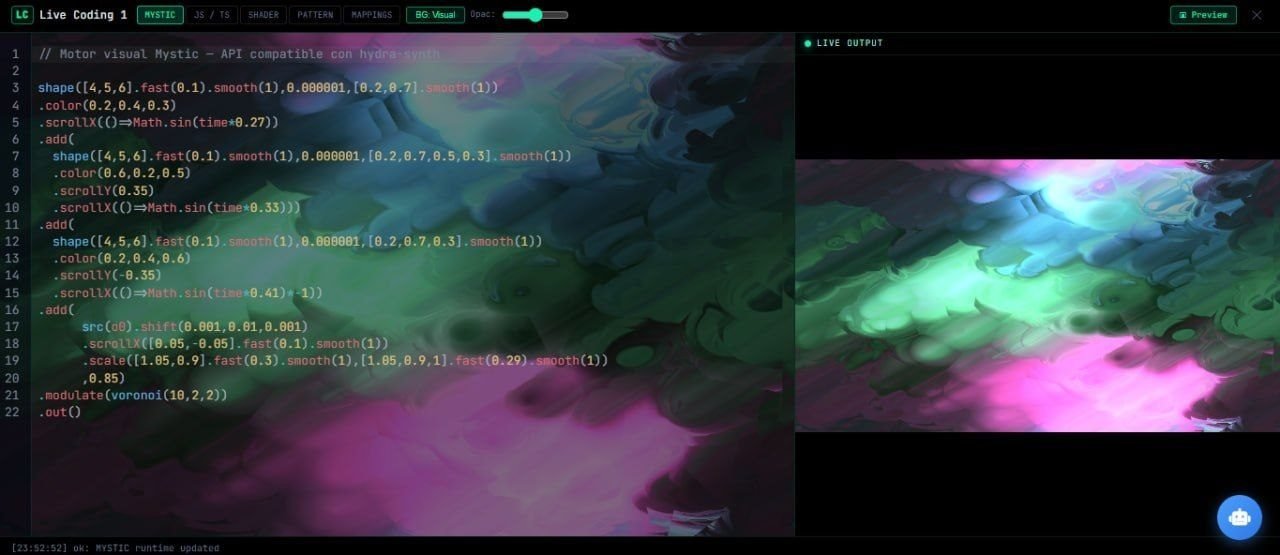
A room connected to a remote server
Metacosmos generates, encodes and injects the visuals from a remote server, and the room is one node connected to that system. The system analyses what is played on stage and passes the data to the server, which transforms it and returns the image to the room through three HDMI outputs. That is why a stable connection without filters is an essential requirement of the work.
The three screens can work as one panoramic sky or as three views of the same system. Screen B, in the middle, carries the layer that the audience changes.
The audience as a node
The audience scans a QR code and opens a controller in the browser, with no app and no registration. From there anyone can tap, drag or send a word. The system adds up all the gestures and applies them within a fixed margin, so the room changes the surface of the work while Gabriel and I hold its structure.
A tap sends a pulse of light that pushes the nearby particles, and hundreds of taps lay the rhythm of the room over that of the music. Dragging a finger moves the field to one side, and the sum of all directions becomes a shared drift on the three screens. Words appear over the image and fade, like thoughts that cross the garden.
The audience’s influence has a ceiling of 25%. If the whole room acts at once, the system scales the gestures down, and the structure of the flight stays recognisable. Anyone who prefers not to use a phone still sees the whole work. The controller asks for no personal data and keeps nothing once the session ends.
Audience influence on the image
The vertical line marks the ceiling set by the artists.
Liminal GardenOnline
No app, no registration, anonymous
Craft, code and stage
Gabriel and I built the technology, the work and the performance at the same time, and the manual work weighed as much as the digital. Every element went through the same cycle of making, testing in the room and starting again. It is the kind of craft people now link with the traditional arts, here inside a contemporary performance.
Kalíptera was born on Gabriel’s workbench, from wooden boxes cut and assembled by hand, steel keys adjusted and tuned, tape hinges and the wiring of its sensors and controls. I programmed Metacosmos for the real needs of live performance, with live coding engines and outputs to several screens that we adjusted at every rehearsal. The instrument and the software were tuned together inside the room. There we decided how each garden sounds, how the image responds and how much the audience takes part.
Sheet and technical rider
The elements marked as essential are the base of the system. Those marked as adaptable are adjusted with the technical team of each venue.
The work
- Title
- Liminal Garden (El viaje de la Kalíptera)
- Year
- 2026
- Type
- Interactive audiovisual performance
- Duration
- 40 minutes
- Media
- Kalíptera, Metacosmos, three screens or projections and the audience’s phones
- Image, system and live coding
- Jaco Casstillo
- Sound and instrument
- Gabriel Barreto (osonoro), creator of Kalíptera
Technical rider
- Internet connectionStable and high quality, with no interference, proxy, restrictive firewall or limited network. A cable to the visuals computer is preferred.Essential
- Video outputsThree HDMI connections to three projectors or screens.Essential
- Audio outputsTwo 1/4-inch TRS connections (6.35 mm jack) for Kalíptera.Essential
- AmplificationA stereo amplification system.Essential
- Audience networkOpen Wi-Fi for the audience or good mobile data coverage in the room.Adaptable
- SpaceA dark room with three projection surfaces. Capacity depends on the venue.Adaptable
- Set-up and testHalf a day of set-up and a full technical test with the real connection.Adaptable

