

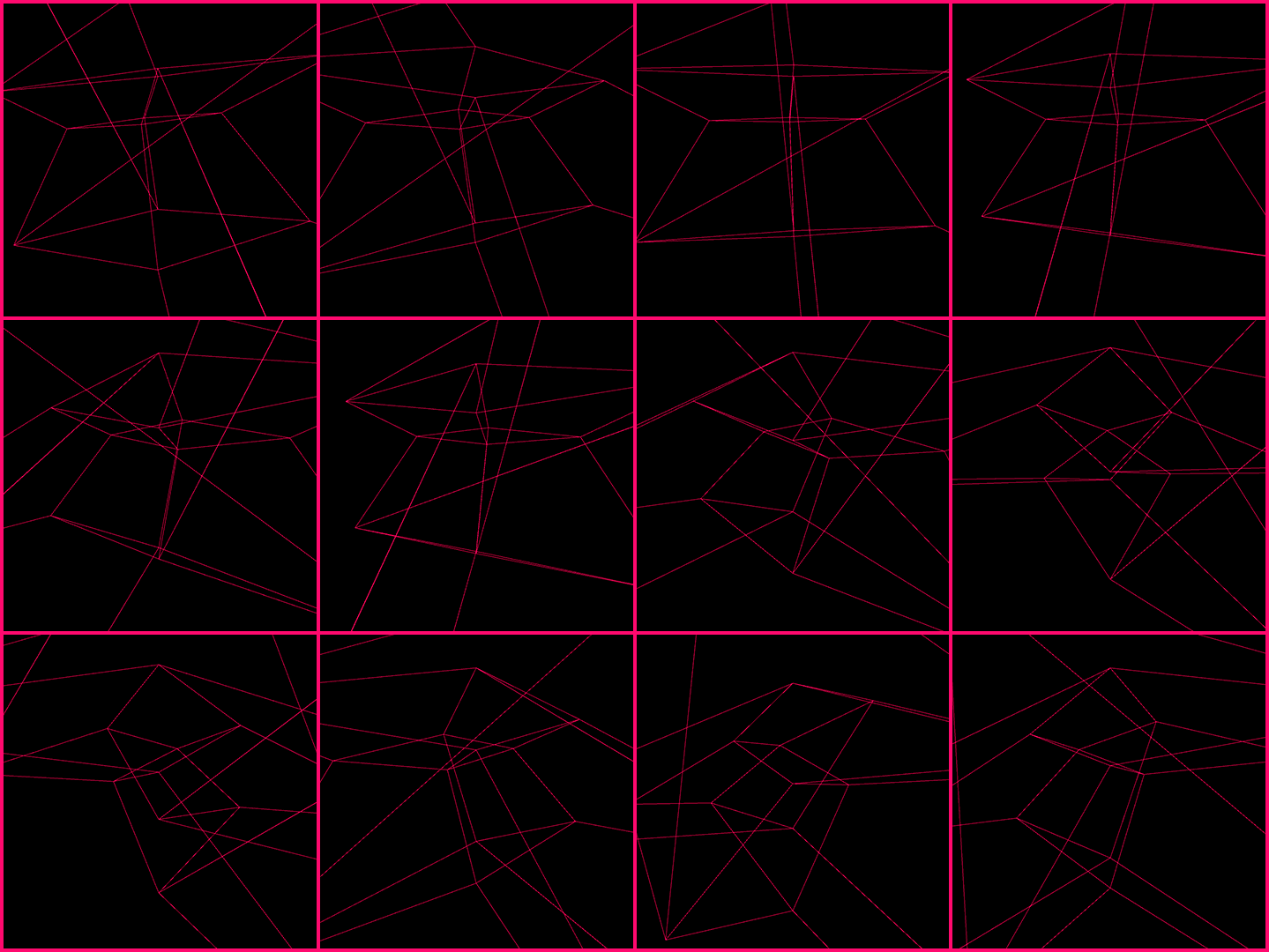
In Tesseract I, I use the hypercube as a sharp metaphor for the digital self: a multidimensional identity that, once it passes through the logic of social platforms, becomes flattened into fragmented two-dimensional projections. I am interested in thinking of each platform as a hyperplane that slices through our volume of identity and reassembles from it only a set of partial surfaces, calibrated not according to the subject’s real complexity, but according to the metrics of attention, visibility, and circulation. In the same way that the tesseract becomes misleading when we attempt to understand it from a lower dimensional framework, the contemporary subject is also distorted when its ontological depth is translated into grids, timelines, or vertical carousels.
With this work, I seek to reveal that the interface has become one of the principal technologies through which the self is interpreted. Our lives seem to acquire density, presence, and even meaning only when they can be projected onto a screen; outside that frame, they risk dissolving into a kind of algorithmic silence. The white lines floating over a black void underscore precisely that condition: we are not facing a stable volume, but rather a simulation of depth whose consistency depends on how many gazes validate it. By compelling the viewer to orbit an impossible object, the piece opens a question that feels central to me: which regions of our identity necessarily remain in shadow when we accept the screen as the final horizon of existence? And how much depth do we lose when we confuse projection with reality, visibility with truth, and interface with being?
Tesseract I turns the hypercube into a sharp metaphor for the digital self: a multidimensional identity flattened by social-media platforms into fragmented, two-dimensional projections. Each platform operates like a hyperplane slicing through our “identity volume,” assembling a mosaic of partial profiles calibrated to the metrics of attention. Just as the tesseract is misread when reduced to three dimensions, the contemporary subject becomes misunderstood when its complexity is translated into grids, timelines, or vertical carousels.
The work reveals that the interface has become today’s primary lens for reading the self: our lives gain “thickness” only when rendered on a screen; outside that frame, they collapse into algorithmic silence. White lines floating against a black void underscore that this volume is simulated and that our reality depends on how many eyes validate it. By compelling the viewer to orbit an impossible object, the piece invites us to question which portions of identity remain in shadow and exposes the loss of depth we incur when we accept the screen as the final boundary of existence.
Mapping the Tesseract’s Rotation
In the animation shown above, a grid of tesseracts rotates, collides, dissolves, and reforms until it condenses into a luminous square. I am interested in thinking of this behavior as a sharp metaphor for contemporary hyperconnected society, where each individual — each hypercube — does not exist as an isolated unit, but as a force that inevitably alters the state of the whole. No presence remains neutral; every emergence introduces a variation, a perturbation, a reorganization of the shared system.
This interactive work explores the interconnection of space, time, and energy, drawing inspiration from space-time theory and the events that structure the universe.
Through the viewer’s interaction and the machine’s random or deliberate intervention, unrepeatable instants emerge, reaffirming how our decisions shape reality: each unique moment arises from a mesh of simultaneous choices woven into the universe’s dynamic fabric.
No account yet?
Create an Account
